

There is something a little uncomfortable about a business repeatedly telling the world how great it is.
We are innovative. We care more. Our service is unmatched. Our people are the best.
Maybe all of that is true. But coming from you, it still sounds a bit like your mom wrote your website copy.
Coming from a client? That is proof.
Testimonials help potential clients understand what it is actually like to work with you. They turn broad claims into specific experiences, add a human voice to your marketing and build trust before a sales conversation even begins.
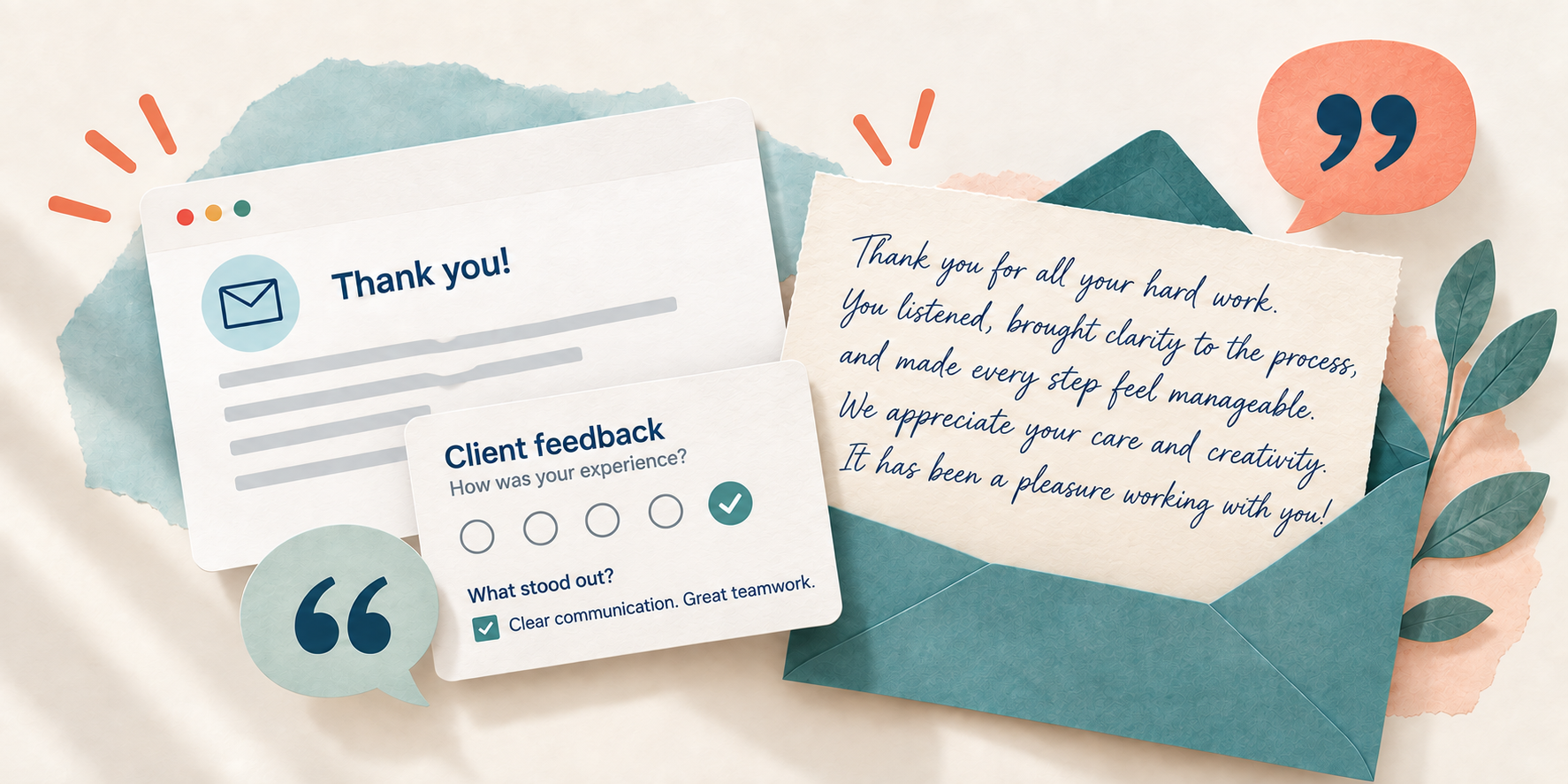
The best part is that some of your strongest testimonials may already exist. They are hiding in thank-you emails, meeting feedback, survey responses, LinkedIn comments and the nice things clients say when nobody has remembered to hit record.
You just need to ask for permission to use them.
Why are client testimonials so effective?
Your audience does not need another polished promise. They need a reason to believe it.
A good testimonial gives them three things your marketing copy cannot provide on its own:
- Credibility: The praise comes from someone who has experienced your work firsthand.
- Specificity: A client can describe the problem, process or outcome in language that feels real.
- Reassurance: Prospective clients can see that someone like them trusted you and was glad they did.
It is the difference between saying, “We make the process easy,” and a client saying, “For the first time, I understood what was happening and knew exactly what I needed to do next.”
One is a claim. The other is evidence.
Ask while the experience is still fresh
Many businesses wait for testimonials to arrive naturally. This is a lovely strategy if you also enjoy waiting for houseplants to water themselves.
Ask when the value of your work is most visible. That might be after a successful launch, a meaningful milestone, a positive meeting or an unsolicited compliment.
The request does not need to be formal. In fact, it is often better when it is not.
Copy-and-paste testimonial request
Hi [Name],
Thank you for your kind feedback about [project or experience]. Would you be comfortable with us using it as a testimonial in our marketing?
If it is easier, you can reply with a few sentences about what you valued most, what changed as a result of our work or what you would tell someone considering working with us. We can lightly edit it for clarity and send it back to you for approval before anything is published.
No pressure at all. We simply appreciate hearing about your experience.
Ask while the experience is still fresh
“They were great!” is nice to hear. It is less useful when it is time to create persuasive marketing.
Give clients a little direction without writing the answer for them. Try one or two of these prompts:
- What challenge were you trying to solve?
- What stood out about the experience?
- What changed after working with us?
- Was there a moment when you knew you had made the right choice?
- What would you tell someone considering working with us?
The goal is not to manufacture a perfect quote. It is to help the client get past the blank page and share something genuine.
Let the client sound like a client
Testimonials should be cleaned up, not scrubbed of all personality.
Fix a typo. Remove repetition. Shorten a winding sentence. But do not turn a warm, conversational response into corporate copy that sounds suspiciously like the rest of your website.
Always get clear permission before publishing a testimonial. Confirm the final wording, how the client would like to be identified and where the quote may appear. Depending on the situation, that could mean a full name and company, a first name and role, or an anonymous description.
If the work involves sensitive financial, legal, health or personal information, privacy matters more than a perfectly attributed quote. A strong testimonial can still be effective without telling the internet everything about the person behind it.
A testimonial is not just a quote box
This is where businesses tend to leave a lot of value on the table.
They collect a great testimonial, place it on a testimonials page and wait patiently for someone to find it.
Instead, let the testimonial lead the content.
A single client story can become:
- A social post or recurring series
- A website callout beside the relevant service
- A short case study
- An email feature
- A sales deck proof point
- A video or audio clip
- A Google
- A theme for a larger campaign
Put the proof close to the promise. If your service page says you simplify a complicated process, place a testimonial about that experience on the same page. If an email promotes a particular service, include a client voice that demonstrates its value.
Your audience should not need to take a field trip to a separate testimonials page to find out whether anyone likes working with you.
How we are helping clients turn testimonials into content
We are currently exploring a client-led social series for Arete Financial called Where Life Takes You.
Most financial firms show charts, market imagery and suspiciously happy couples staring at the horizon. This concept shows clients living the lives they have worked and planned for.
Clients take a photo of an Arete travel mug somewhere meaningful. It could be overlooking the Amalfi Coast, sitting on a cottage dock, joining a family camping trip or watching the grandkids play hockey in another province. Each post can include the location, a sentence about the experience and, when appropriate, a short client quote.
The focus stays on the client’s journey. Arete does not need to take credit for the trip. The story naturally demonstrates the bigger idea: financial planning can create more freedom to experience life.
That is what we mean when we say a testimonial can become a content leader. The client experience is not added at the end to validate the marketing. It inspires the marketing.
The concept can also grow over time. New clients could receive a travel mug with a note asking, “Where will your plan take you?” Client photos could become an annual collage or video. A single idea creates an ongoing stream of warm, inclusive and genuinely client-centred content.

Testimonial best practices
Before you start mining your inbox for compliments, keep these principles in mind:
- Ask at the right moment. Make the request when the positive experience is recent and specific.
- Provide prompts. A few thoughtful questions lead to stronger answers than “Can you send us a testimonial?”
- Keep it genuine. Edit lightly and preserve the client’s natural voice.
- Get permission. Approve the wording, attribution and intended use before publishing.
- Use specifics. Concrete experiences are more believable than general praise.
- Protect privacy. Never trade a client’s comfort or confidentiality for a stronger marketing asset.
- Place testimonials strategically. Match the quote to the service, audience or concern it supports.
- Think beyond one post. Look for ways the story can shape content across multiple channels.
- Keep asking. One excellent quote is helpful. A steady mix of client voices is more representative and more useful.
Yes, we are taking our own advice
We tell our clients to ask for testimonials, make them visible and let real experiences guide the content. So, naturally, we need to do the same.
We are gathering the notes, emails and kind words our clients have shared with us, asking permission and finding better ways to bring those voices into our website, emails and social content.
A recent note from Schneider Electric’s Chelsea Pacella said it best:
“This campaign genuinely made a huge splash for us and our partners. You guys did an incredible job. My sincerest thank you to the team. We were finally able to get the visibility we needed thanks to this campaign’s success.
Thank you for being such valuable partners, meeting us where we’re at and helping us accelerate. You’ve really helped us level up up this year.”
Chelsea Pacella
Transactional Business Lead, North America Operations, Schneider Electric
Feedback like this carries a credibility no polished marketing claim can replicate. It is exactly why you will be seeing more client voices across our marketing.
Good marketing does not always require another clever claim. Sometimes it requires stepping out of the spotlight and letting the people who know your work tell the story.
So stop saying you are great.
Ask your clients. They may say it better anyway.
Ready to put your clients’ words to work?
We can help you find the stories already hiding in your inbox, ask better questions and turn genuine client feedback into content that builds trust.
Let’s turn your proof into your next great piece of content.